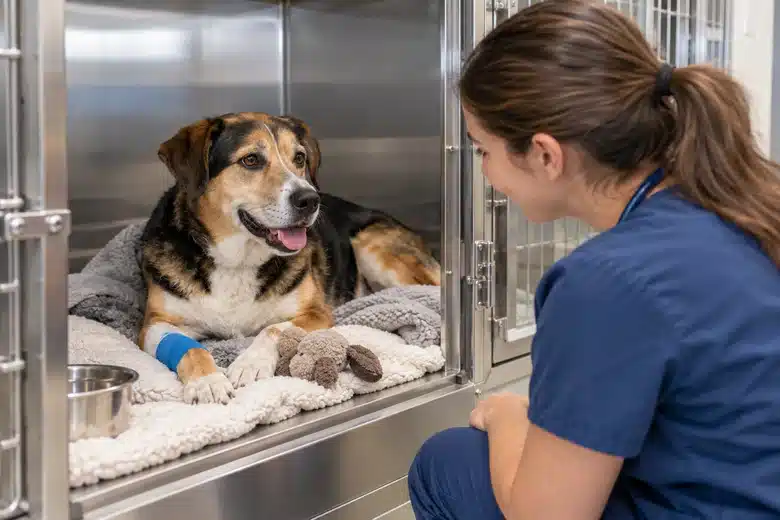
Pet Insurance That Covers Hospitalization
How to tell whether an inpatient stay is an insured treatment, with a line-by-line admission and claim check.
What matters on this page
Use these checkpoints to frame the literal question before reading the full guide.
Pet insurance can cover hospitalization when the admission is medically necessary for an eligible accident or illness. The decisive language is the covered-treatment provision together with exclusions, waiting periods and the reimbursement rules. An overnight stay, by itself, does not establish coverage.
The sections below show how to verify the answer and what can change it.
Locate hospitalization in the contract
Lemonade’s public pet overview names hospitalization among its accident-and-illness procedures. That is a useful product example, but it does not turn every inpatient charge into a reimbursable expense. The actual event, start date, history and selected benefits still need to fit the policy.
Begin with the admission reason and clinical notes. “Observation” may describe active monitoring after treatment or simply time in a kennel; the word alone does not settle the insurance question. Ask for an itemized estimate that identifies the medical purpose of admission, each planned test, drugs and monitoring, plus any nonmedical boarding charge.
Read the inpatient invoice in parts
| Invoice item | Indication/history | Relevant provision | Inclusion evidence | Unresolved question |
|---|---|---|---|---|
| Admission or examination | Why the clinician admitted the pet | Exam-fee and covered-treatment clauses | Written indication and selected exam benefit | Is the professional examination fee separate? |
| Inpatient monitoring | What signs or treatment require observation | Medically necessary care definition | Nursing record and monitoring frequency | Is the billed service medical monitoring or boarding? |
| Drugs and fluids | Treatment of the admitted condition | Medication benefit and exclusions | Prescriptions and administration record | Are take-home drugs billed separately? |
| Diagnostics | What condition the test investigates | Diagnostic benefit and prior-condition language | Test order, results and dated history | Does the claim involve an excluded pre-existing problem? |
| Boarding or convenience stay | No treatment indication established | Nonmedical care exclusion | Separate line and discharge notes | What extra nights are unrelated to medical necessity? |
Inpatient monitoring
Drugs and fluids
Diagnostics
Boarding or convenience stay
Follow one admission without assuming the result
In an invented example, a dog is admitted for a new illness and the bill is $2,400: $150 examination, $650 tests, $1,300 inpatient treatment and $300 nonmedical boarding after discharge. Suppose, solely for illustration, the examination and boarding are excluded. The eligible base is then $1,950. With a hypothetical deductible-first formula, $250 remaining deductible and 80% reimbursement, payment would be ($1,950 − $250) × 0.80 = $1,360, subject to the remaining limit. The owner retains $1,040 of the total invoice.
That example deliberately separates eligibility from arithmetic. If the underlying illness were excluded, even accurate arithmetic would not create a benefit. If the policy applies the percentage before the deductible, the result also changes. Obtain the real payment provision rather than borrowing the example’s order of operations.
Ready to check current rates?
Keep policy terms, deductible, reimbursement and limits beside the quote so the comparison stays consistent.
Cash at admission and reimbursement later
An admission deposit and eventual insurance reimbursement are different obligations. Pennsylvania’s consumer guide explains that most plans reimburse after the owner pays the veterinarian. Budget for the clinic’s immediate payment terms unless a specific direct-payment arrangement has been confirmed.
Put these in the claim file
Urgent treatment comes first
For a pet that may need emergency admission, follow the treating veterinary team’s advice. Do not delay necessary care while comparing insurance pages; a new policy should not be assumed to finance an already developing emergency.
When the insurer needs more detail
If a claim decision excludes an inpatient charge, compare the explanation with the exact invoice line and policy provision. A factual correction, such as an incorrect service date or a boarding label applied to documented treatment, is different from disputing a contractual exclusion. Ask the veterinary practice for an accurate record rather than a new label designed to obtain payment. Keep the original decision and any corrected documents together.
Common questions
Does a hospital stay mean the whole bill is covered?
No. The admission reason and each billed service still have to satisfy the contract.
Can observation count as treatment?
It may, when it is medically indicated and covered under the policy. The record must establish what monitoring was performed and why.
Does preauthorization guarantee payment?
Read its terms. A preliminary assessment may still depend on records, eligibility and the final invoice.
Independent references
These links provide independent government, academic or reference background. Actual policy wording controls insurance eligibility, benefits and claims.
Ready to compare with clearer inputs?
Keep the policy terms beside the price, then continue to rates when the comparison is clear.